Wednesday, January 30, 2013

Vanity or Worship? Ex 38-40


I know it's a small thing, but look at Ex 38:8:
They made the bronze basin and its bronze stand from the mirrors of the women who served at the entrance to the tent of meeting.

Mirrors...a symbol of our vanity...for women, it is proof that our identity is still tied to our beauty...

So what does it mean when the women who serve at the entrance to the temple gladly give up their mirrors to create a huge wash-basin? 

It means they are clean and their identity is wrapped up in their God, not their own glory.  It means that generations of children will learn to identify a beautiful woman by the character of her service and worship rather than the color of her eyes or hair.  It means that the hearts of the moms and grandmothers are personally invested in following this God, wherever He goes. 

To God, it means everything.  At the end of Chapter 40, we see God fill the tabernacle with His Glory to the extent that even Moses cannot enter.  We see that the Angel that God is sending to lead them is none other than Himself. 

God dwells with us when we choose real worship over self-worship.  The exchange is worth it.

Monday, January 28, 2013

Discipline and Obedience: Ex 35-37


Have you ever noticed that as soon as you discipline your kids they are really snuggly? 

Yesterday's reading was a nightmare--like watching a train wreck.  They messed up.  The punishment was severe and deserved.  It's time to create the tabernacle using the designs Moses recieved from God, so what's going to happen when Moses comes to the people and asks for materials?  The design God gave Moses to implement is the most elaborate worship tent ever conceived--a tent that is intended to mirror the very atmosphere of Heaven itself.  Will the people want to give to God after such a messy confrontation?

You betcha--and in a big way.  They even had to tell people to stop bringing stuff. 

A few years ago, Bruce Wilkerson came to speak at our church about intimacy with the Almighty. There were several God appointments ordained for that weekend, including the obvious failure of the body of Christ to address the needs of our community, but in essence the strongest point from his sermon was one that Jesus made in Matthew 6:

"21 For where your treasure is, there your heart will be also."

That weekend, our church pledged $5.6 Million to help combat homelessness in Orlando.  Both here in Orlando and in Israel, the gifts didn't just include things--they included time, talent, expertise and energy.  When God does something, He uses crisis and correction to move us where we need to be to be a part of a miracle.  In both cases, God provided people with expertise long in advance of the visible action, but when it is time, it all comes together and becomes something amazing. 

What have you given God lately?  Do you need a crisis to get you to that point?

Sunday, January 27, 2013

Doing something or Being Something: Ex 32-34


Uncertainty tests us like nothing else.  It's at that moment we find out who we really are and what we care about. 

When Aaron is faced with a group of people that are pushing him for leadership, he does something--something stupid.  He, along with all of the people have just committed to God to do all He commands and the first command is that they will have no other gods.  They haven't heard anything from God.  They don't want to hear from Him.  Moses has disappeared.  They want to worship something so they can move on and a statue is a lot easier to control than a big, scary real God.  Things go south from there.  If you make your own god, you get to make up the rules for worshipping it, which means you do whatever you feel like doing--in this case it became a drunken orgy.  The real God and Moses are not amused. 

Moses doesn't do something first, he reminds God of who they are and who God is.  His first concern is with God and the relationship that defines this people.  After God agrees not to destroy them, Moses goes down to see for himself.  His anger is at a people who chose activity over identity.  They had been chosen as God's own, but rather than wait for God to act, they chose to act instead, picking a new god for themselves. 
At that point, he asks the people to choose for themselves who they are going to be.  The Levites are God's chosen tribe--the priesthood--and they choose God for themselves.  The slaughter that follows seems cruel, but in the context of having a second chance to keep their own commitments and follow God, their betrayal of God is even more obvious. 

Eventually, the people quit wearing their jewelery and put on old clothes to mourn their sin, but it appears more like the regret of getting caught than real repentence.  They still don't understand who God has called them to be.  In contrast, Moses begs God to shown him his Glory because who God is defines who Moses is.  God walks past Moses declaring his name--a name that includes both forgiveness and justice.  After seeing God, Moses ultimately appeals to God on the basis of their identity.  The only thing that sets the Israelites apart is that God travels with them.  His presence is their identity.  This is truth, and God agrees, but He also reminds the people through Moses of the way that people with that identity will act.  When Moses returns, he has been changed by his contact with God and carries something of God's own glory back to the people. 

For years, God would stop me in the middle of my busy-ness and remind me that I had become a human doing again rather than a human being.  Over-doing is often a sign we are trying to become something we really aren't.  We will act out of our highest identity when we really understand that it doesn't come from what we do, but who has called us out to Himself.  He doesn't need us to DO anything other than be His children.  When we really get who we are, we will begin to act like it.  We will do what we are called to do, but not to prove to God who we are.  We will do it because we finally believe Him when He calls us His own.   

What about you?  Are you defined by what you do or who you are?

Set apart: Ex 29-31

In our day, we have very little that shows us the difference between the sacred and everything else.  Part of that is good, because for those who are set apart in Christ, all things are sacred and each of us is their own priest before the Father and is called to minister.  Before we can minister effectively to each other, God has work to do in and through us.  We often forget the components of a set-apart, Holy unto God, lifestyle--the lifestyle He desires for all of His children. 

The ordination of the priests shows much of what God does for us and with us when He calls and prepares us to serve Himself and His people:
  • Garments and sacrifices are prepared for the priest.  These are not his things.  They are gifts to him and for him to set him apart for God's purposes.  
  • Aaron and his sons are washed and dressed in priestly robes.  Each action is passive.  Repentence (the washing--remember John's baptism for repentence?) is something God works in our hearts.  Even dressing is done for them--again, a preparation God gives us.  Check out how closely the pieces of the priestly robes match the armor of God:
    • The helmet of salvation:  The turban with it's crown declaring "Holy to the Lord"
    • The breastplate of righteousness: the ephod and robe
    • The belt of truth:  A sash around their waist
    • Shoes: These are not mentioned, but clean feet and hard work imply them
    • The shield of faith:  The chestpiece with the twelve stones and the urim and thummim
    • The Sword of the Spirit:  A priest was not in the physical battles (for the most part) so he is covered with the sacred anointing oil, which symbolizes the Holy Spirit and the spiritual nature of the battles he will fight.
  • The first sacrifice made for the priest is the sin offering.  Aaron lays his hands on the head of the bull--symbolizing his willingness for the sacrifice--and a young bull is slaughtered and burned outside of camp.  When we come to Christ, we start with the repentence provided by God (the washing) but before we can be of service to God, we must also willingly offer that "bull-headed" sin up to God so that He can kill it, take it out of our lives and burn it to ash. 
  • The first ram is a gift offering.  The priest laid hands on it (like the bull) and then it was slaughtered, washed and burned on the altar.  Again, the ram is a gift provided to Aaron as he is being set apart, but the priest must be willing to have his gift killed, washed and destroyed.  God provides each of us with spiritual gifts, but before they are useful to God we must first be willing to see them lose their usefulness, be purified, and destroyed as an offering for God.  For those of us who have been prepared for ministry, this process seems shocking.  God gives us a great gift and the first thing He does is kill it, clean it, and then burn it to ash--as if it could never reappear.  Until we are willing to submit our gifts and talents to God's will--even to death, if necessary--those gifts are unusable to God. 
  • The second ram seems to be going the same direction as the first.  It also must be willingly slaughtered, but this time the blood, the life of the gift, goes on the priest's dominant earlobe, dominant thumb and dominant toe.  As we again give up what has been given to us, God uses it to give life to our hearing, our doing and our going.  The fat and the bread of God's presence again willingly goes on the altar--the first and best always goes back to Him.  The breast and thigh are also willingly lifted up to the Lord, but (surprise!) these come back to him as his portion.  It is boiled and must be eaten in God's presence.  The blessings God provides for us to keep still require work and can only be enjoyed in continual communion with God.  From then on, this portion of the people's peace offering is given to the priest.  Those who minister are blessed by those they nurture as those people walk into the peace God has for them.
  • For the first seven days of his ministry, the same sin sacrifice is offered each day and the altar, the altar must be cleaned out and anointed with oil each day.  This provides training and sets good habits in place within the one who ministers.  Each day, those who serve God must bring their sin before God, repent and receive the anointing of the Holy Spirit.  This is especially important in the beginning, but it will continue throughout his ministry.
  • Through the rest of his ministry, he will wash himself and offer morning and evening sacrifices that include meat, bread, oil and wine--the stuff of their lives.  During these times of sacrifice, God will meet with them and speak with them.  We also repent each day, setting time and resources aside, each morning and evening, so that we can hear from God. 
  • The priest will also offer incense each morning and evening.  Incense is symbolic of the prayers offered on behalf of the people. 
  • All of the stuff used within the temple are divinely prepared through God's inspiration to gifted craftsmen, who are divinely set apart to prepare those things, just as our Bible was provided through the use of gifted men, divinely set apart and inspired to prepare for us the tools we use to worship God. 
The final instructions regarding the sabbath applied to all of Israel, except to the priesthood, for their ministry continued every day, and actually increased on the Sabbath.  Worship is not considered work, and for those of us called to it, it is a blessing not a chore.  Priests did have rotations and did rest, but remained in a continual state of worship.  In Hebrews, we are taught that Jesus is our sabbath rest.  He works in and through us every day, just like the priests worked every day before God. 

Friday, January 25, 2013

Glorious and Beautiful: Ex 26-28


Worship can take many forms.  It's easy to think of worship in terms of music or poetry, but it is so much more.  Worship is anything that shows God how important He is to us.  These three chapters seem pretty ordinary on the surface, but they show two things:  God is worthy of things that are our highest and best craftsmanship and God does care about the gifts He receives.  Everything that is specified is described as "Glorious and Beautiful,"  and it was.

The creation of the tabernacle, the equipment and the clothing for the priests according to the plan God made for them was a unique act of worship.  The materials were all given by the people.  They were treated with great care and forthought.  Later we will see the names of the craftsmen that God supernaturally gifted to create these beautiful pieces.  God didn't mind letting us know who crafted these beautiful pieces, but we see that the ability to create them was a gift from God, returned to God. 

Many of the pieces were symbolic.  Cherubim were featured everywhere, just as they are in Heaven. The high priest wears a gold plaque on his turban that declares he is "Holy to the Lord."  The breastplate is over his heart along with the urim and thummim--a sacred way that God used something like dice to show His will.  He carried onyx stones on each shoulder engraved with the names of the 12 tribes of Israel to remind him that he is their representative. 

There are times for me when I create something and I put everything I have into it just to praise God.  Imagine having God's direction about what He wants and then going after satisfying that with every resource you have.  What a delight!  This too is worship. 

What can you do to worship Him today?

Dinner with God: Ex. 23-25


"9 Then Moses, Aaron, Nadab, Abihu, and the seventy elders of Israel climbed up the mountain. 10 There they saw the God of Israel. Under his feet there seemed to be a surface of brilliant blue lapis lazuli, as clear as the sky itself. 11 And though these nobles of Israel gazed upon God, he did not destroy them. In fact, they ate a covenant meal, eating and drinking in his presence!"  Ex 24:9-11

Did you miss that little snippet?  We know Moses spent a lot of time with God, in His presence, but can you imagine what it was like to be there for this dinner?  Later we see God's glory envelope the mountain, appearing as a consuming fire, with Moses disappearing into it, but in this section, it's almost as if God turns down the lights for a romantic dinner with His people's leaders, celebrating their new relationship. 

Remember this moment.  Don't rush by it.  The leaders of the people get an unprecedented audience with the King of the Universe.  They see Him, for themselves.  He does not break out against them but welcomes them.  He has promised a messenger to lead them.  He has promised to care for all their needs in abundance and they have agreed to follow His way.  It's a great honeymoon moment. 

God has been completely patient with all their requests and understands all their needs.  He loves them and chooses to allow them to be close to Him, with the blood of the covenant still staining their robes.  There will be much work to do to prepare a tabernacle for His presence to remain with them, but for this moment, He furnishes the plates and dishes and feast. 

Worship Him.  He is worthy!

Thursday, January 24, 2013

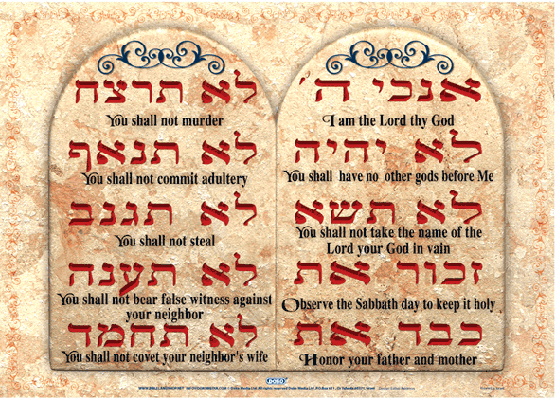
The Rules for Life: Ex 20-23:13


Parts of this are probably pretty familiar to most of you.  This is the first time Israel gets a look at the terms of the relationship they are entering into with God.  There are three major themes.

God if first, highest, best, and jealous.  God prioritizes His relationship with them as above all others.  He is not like other gods.  He doesn't share.  He cares what you care about.  He can't be imaged and worship of Him is to be pure and singleminded.  If you want something supernatural, get it from Him and only Him.  He gets part of everything returned to Him, including your time, because it all comes from Him in the first place.

Authority exists, with God as the highest, best and kindest authority.  He will be the final arbiter of all disputes, but there are other authorities that can be used to address injustice.  God is honest so his people need to be honest too.

Treat each other right.  Don't take each other's stuff.  Don't even want each other's stuff.  If a man has nothing else to pay his debts with he can offer his own labor or the labor of his family for a period of time, but there are limits to that relationship.  There are consequences when you hurt someone else. 

The king was to write out all of the rules so that he would have his own personal copy to read each day.  Joshua was told to be careful to keep all of the words of the law and read them continually.  These kinds of rules were the laws they were talking about.  They show how profoundly God understands the nature of the relationships we walk in each day.  (I've used Ex 21:15 and 17 as threats). 

I'm convinced that the saddest verse in the entire Bible is Exodus 20:19:

"19 And they said to Moses, “You speak to us, and we will listen. But don’t let God speak directly to us, or we will die!” 

I understand their fear, but not their reaction.  Yes, God is big and powerful and can be scary.  That's no reason to run away.  This is the God that just rescued you from slavery and feeds you every day.  You need to know who He is. 

One of the things I've asked this year is to have the courage to stand boldly in His Glory because of the sacrifice He made for me.  I know He is overwhelming, but He is good.  I know I have no right outside of His grace, but I want to fully accept that grace.  Job once said, "Though He slay me, still I'll trust in Him."  I want His presence, even if it means tremendous sacrifice because He is worthy.  Better to be slain in His presence than spend even a moment without Him.  He is worth it.

Would you want to run or want to stay?